How to Choose a Note Format in WellNotes
How to pick a note format in WellNotes: the 15 formats in the note editor, what each one is best for, and when to create a custom template instead.
Last updated:
To choose a note format in WellNotes, pick one of the 15 formats from the template selector in the note editor before you generate the note. Each format structures your documentation differently, from SOAP (Subjective, Objective, Assessment, Plan) to specialized formats like BIRP for community mental health and GIRP for goal-oriented practices. Choosing the right one helps your notes match what your payers expect and reflect your clinical work.
Which note format fits your setting?
| Format | Sections | Best For | Common In |
|---|---|---|---|
| SOAP | Subjective, Objective, Assessment, Plan | General therapy, insurance billing | Outpatient therapy, multidisciplinary teams |
| DAP | Data, Assessment, Plan | Faster documentation, behavioral health | Outpatient behavioral health, counseling |
| BIRP | Behavior, Intervention, Response, Plan | Measurable outcomes, substance use | Community mental health, substance use treatment |
| GIRP | Goal, Intervention, Response, Plan | Goal-oriented progress tracking | Treatment plan-focused practices |
| SIRP | Situation, Intervention, Response, Plan | Crisis and acute care sessions | Crisis intervention, acute settings |
| PIE | Problem, Intervention, Evaluation | Problem-focused documentation | Case management, social work |
| Treatment Plan | Clinical assessment, goals, objectives, interventions, progress indicators | Intake and periodic reviews | All clinical settings |
| Clinical Supervision | Administrative items, cases reviewed, clinical development, plan | Documenting supervision sessions | Licensure and BCBA supervision |
| Intake Assessment | Presenting problem, history, mental status, diagnosis, recommendations | First-session documentation | All clinical settings |
| Group Therapy Note | Group process, individual contributions, interventions, group response, plan | Group session documentation | Group therapy practices |
Each format name links to its template with filled examples. See all 15 in the therapy note templates library.
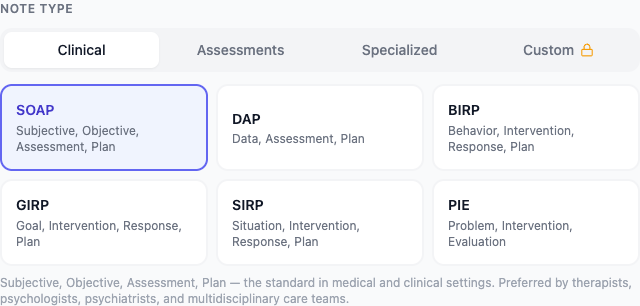
Which note formats can you choose from?
- 1
SOAP: Subjective, Objective, Assessment, Plan
The most widely used clinical format. Preferred by therapists, psychologists, and multidisciplinary care teams, and widely accepted by payers (check each payer for its own requirements).
- 2
DAP: Data, Assessment, Plan
A streamlined 3-section format common in behavioral health and outpatient settings. Combines subjective and objective data into a single "Data" section.
- 3
BIRP: Behavior, Intervention, Response, Plan
Focuses on measurable behavior and intervention outcomes. Popular in community mental health and substance use treatment.
- 4
GIRP: Goal, Intervention, Response, Plan
Goal-oriented format that ties interventions directly to treatment plan goals. Useful when documentation must reflect measurable progress.
- 5
SIRP: Situation, Intervention, Response, Plan
Designed for crisis and acute care sessions where the presenting situation is the primary documentation focus.
- 6
PIE: Problem, Intervention, Evaluation
Common in case management and social work. Organizes documentation around specific identified problems.
- 7
Treatment Plan
A structured plan document listing diagnosis, long-term goals, short-term objectives, and interventions. Used for intake and regular reviews.
- 8
Clinical Supervision Note
Documents a supervision session: hours and format, cases reviewed, the supervisee's clinical development, and follow-up items.
- 9
Intake Assessment
A comprehensive first-session documentation format capturing presenting concerns, history, risk factors, and initial clinical impressions.
- 10
Group Therapy Note
Adapted for group session documentation. Captures group dynamics, individual participation, and shared interventions.
What tips save time?
- Not sure which format to use? SOAP is a safe default for most outpatient therapy settings.
- Your template choice is saved per note: you can use different templates for different clients or session types.
- Custom templates let you describe your own note structure in your own words (Professional plan).
Frequently asked questions
What is the difference between SOAP and DAP notes?
SOAP notes have four sections (Subjective, Objective, Assessment, Plan) while DAP notes have three (Data, Assessment, Plan). DAP combines subjective and objective information into a single "Data" section, making it faster to complete. SOAP is the more widely recognized format across healthcare; DAP is common in outpatient behavioral health. Payer requirements vary, so check yours.
Which clinical note format do insurance companies require?
Most insurance providers accept SOAP notes as the standard format. However, requirements vary by payer, so check with your specific insurance company. WellNotes generates notes in SOAP, DAP, BIRP, and other commonly used formats.
Is a WellNotes note a progress note or a psychotherapy note?
WellNotes drafts progress notes: the session record with interventions, symptoms, progress and plan. Under the HIPAA Privacy Rule (45 CFR 164.501), psychotherapy notes are a therapist's separate notes analyzing the session conversation, and they cannot contain summaries of diagnosis, symptoms, treatment plan or progress. See our guide to process notes vs progress notes on the WellNotes blog.
Can I create a custom note template for my practice?
Yes. WellNotes Professional plan users can create custom templates by writing generation instructions (up to 2,000 characters) that describe the sections and format they want. This is useful for specialized practices like ABA therapy, trauma-focused CBT, or any setting with unique documentation requirements.
What note format is best for ABA therapy documentation?
For ABA (Applied Behavior Analysis) therapy, BIRP (Behavior, Intervention, Response, Plan) is commonly used because it focuses on measurable behavior and intervention outcomes. Alternatively, you can create a custom template with sections like Antecedent, Behavior, Consequence, and Data Collection using WellNotes' custom template feature.
Sources
Related articles
Still have questions? Email our support team (we typically respond within one business day).